Austrian Cities, Austrian Culture, Austrian
Hotels, Austrian News, Austrian
Regions, Austrian Tourism, Austrian Tours, Kaffehauskultur.
Travel to Austria.
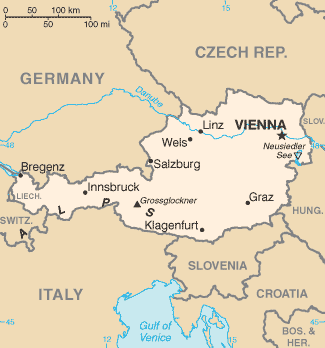
The capital of Austria is Vienna.
Austria
Maps.

The flag of Austria is three equal horizontal bands of red (top),
white, and red.
Once the centre of power for the large Austro-Hungarian Empire,
Austria was reduced to a small republic after its defeat in World War I.
Following annexation by Nazi Germany in 1938 and subsequent occupation
by the victorious Allies in 1945, Austria's status remained unclear for a decade.
A State Treaty, signed in 1955, ended the occupation, recognised
Austria's independence, and forbade unification with Germany. A constitutional law that
same year declared the country's 'perpetual neutrality' as a condition for Soviet military
withdrawal.
The Soviet Union's collapse in 1991 and Austria's entry into the
European Union in 1995 have altered the meaning of this neutrality.
A prosperous, democratic country, Austria entered the EU Economic
Monetary Union in 1999.
Geographically
Central Europe - north of Italy and Slovenia.
Administrative Divisions
9 states:
(Bundeslaender, singular - Bundesland)
Burgenland; Karnten (Carinthia); Niederoesterreich (Lower Austria);
Oberoesterreich (Upper Austria); Salzburg; Steiermark (Styria); Tirol; Vorarlberg; Wien
(Vienna).
Independence
976 (Margravate of Austria established).
17th September, 1156 (Duchy of Austria founded).
11th August, 1804 (Austrian Empire proclaimed).
12th November, 1918 (republic proclaimed).
National Holiday
National Day: 26th October - Commemorates the passage of the law on
permanent neutrality.
Kaffehauskultur Wien.
Add a Business Listing - Add a Destination Guide - Add a Place to Stay.
 If you find Travel Notes useful, please take a moment to like us on
Facebook and share with your friends on social media. If you find Travel Notes useful, please take a moment to like us on
Facebook and share with your friends on social media.
Europe Index -
Europe Tourism
- Europe Travel Websites.
|