 Montenegro Travel Guide - Beaches, Mountains & Historic Towns

.
Travel Notes: Europe - Montenegro Travel Notes.


Short URL: https://tnot.es/ME
Montenegro Travel and Tourism on Travel Notes
Visiting Montenegro - Stunning Coastline and Mountain Landscapes
Discover why Montenegro should be your next adventure. Enjoy the beauty of a Balkan nation with a dramatic coastline and majestic mountain landscapes.
About Montenegro
Montenegro offers a unique blend of natural beauty, rich history, and warm hospitality; making it an increasingly popular destination for travellers.
With soaring mountains, pristine lakes, and sunny beaches, Montenegro is a beautiful country that provides a variety of options for visitors seeking diverse experiences in a relatively small and picturesque country.
Countries neighbouring Montenegro: Bosnia-Herzegovina, Croatia, Serbia, Kosovo and Albania.

 Add a Business Listing -
Add a Location -
Add a Lodging - Add Travel Content
- Add URL
- Travel Services.
Add a Business Listing -
Add a Location -
Add a Lodging - Add Travel Content
- Add URL
- Travel Services.
Mapping Montenegro
Map of Montengro
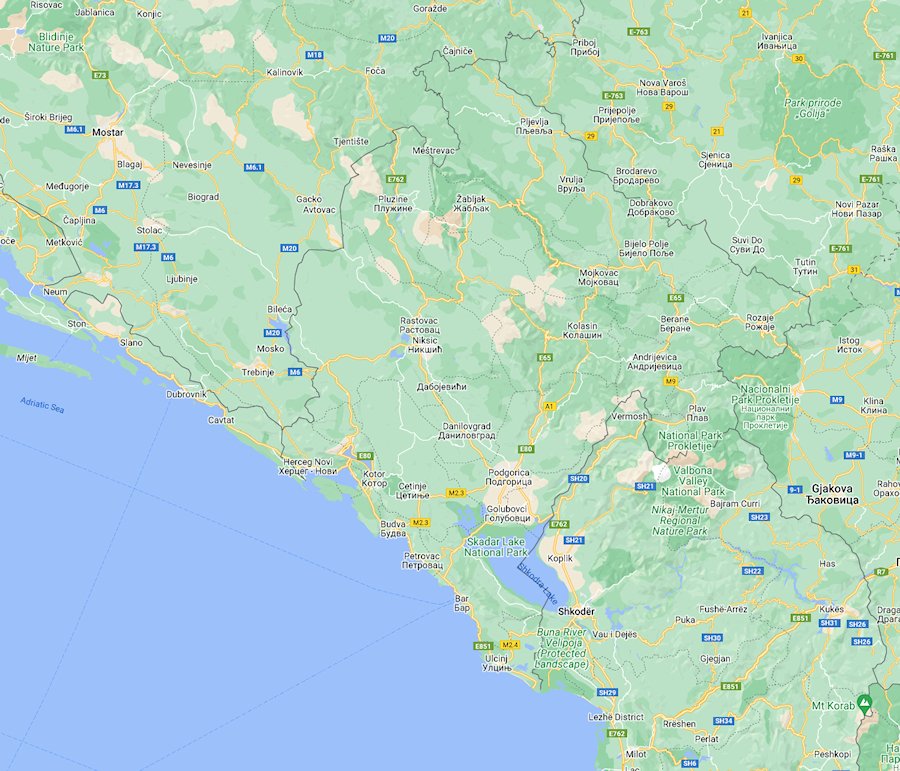
Montenegro has a small coastline along the Adriatic Sea.
Popular destinations in Montenegro include the coastal town of Budva, Kotor old town, and Ostrog monastery.
The capital of Montenegro is Podgorica.
Montenegro Overview
Montenegro is a country located in South-eastern Europe on the Balkan Peninsula.
Montenegro is bordered by Croatia to the west, Bosnia-Herzegovina to the north-west, Serbia to the north-east, Kosovo to the east and Albania to the south-east.
Administrative Divisions
21 municipalities:
(opstine, singular - opstina)
Andrijevica; Bar; Berana; Bijelo Polje; Budva; Cetinje; Danilovgrad; Herceg Novi; Kolasin; Kotor; Mojkovac; Niksic; Plav; Pljevlja; Pluzine; Podgorica; Rozaje; Savnik; Tivat; Ulcinj; Zabljak.
Brief History
Montenegro has a rich history that dates back to ancient times.
It was a part of various empires and kingdoms throughout its history, including the Roman Empire, Byzantine Empire, and Ottoman Empire.
Montenegro declared independence from Serbia in 2006, becoming a sovereign nation.
The use of the name Montenegro began in the 15th century, when the Crnojevic dynasty began to rule the Serbian principality of Zeta.
Over subsequent centuries Montenegro was able to maintain its independence from the Ottoman Empire.
From the 16th to 19th centuries, Montenegro became a theocracy ruled by a series of bishop princes; in 1852, it was transformed into a secular principality.
After World War I, Montenegro was absorbed by the Kingdom of Serbs, Croats, and Slovenes, which became the Kingdom of Yugoslavia in 1929. After World War II it became a constituent republic of the Socialist Federal Republic of Yugoslavia.
When the latter dissolved in 1992, Montenegro federated with Serbia, first as the Federal Republic of Yugoslavia and, after 2003, in a looser union of Serbia and Montenegro.
Cities and Towns
The capital and largest city of Montenegro is Podgorica.
It serves as the administrative, economic, and cultural center of the country.
Other notable cities include Budva, a popular coastal resort town known for its historic old town; and Kotor, a charming medieval town situated on the Bay of Kotor.
Cultural Heritage
Montenegro has a rich cultural heritage influenced by various civilisations and cultures.
The country's architecture, cuisine, and traditions reflect this diversity.
Montenegrins are known for their hospitality and strong sense of national pride.
Currency
The official currency of Montenegro is the Euro (€), although it is not a member of the Eurozone.
It adopted the Euro unilaterally in 2002.
European Integration
Montenegro is a candidate country for membership in the European Union (EU).
It has been making efforts to align its legislation and institutions with EU standards.
Highlights
Montenegro is a magical destination that beautifully blends stunning coastal scenery with dramatic mountainous landscapes.
Starting from the beautiful Bay of Kotor, visitors can explore atmospheric streets in the UNESCO-listed old town of Kotor, with highlights such as the three city gates, town square, clock tower, and the Cathedral of Saint Tryphon.
The Bay of Kotor itself is a breathtaking fjord-like bay that offers both cultural charm and natural beauty.
Heading north, the landscape transforms into the wild and wonderful Durmitor National Park, a UNESCO World Heritage Site known for its rugged mountains, deep canyons, and pristine lakes.
Durmitor is a paradise for nature lovers and adventure seekers, offering magnificent hikes, scenic drives, and opportunities for lake swimming.
The park’s highest peak, Bobotov Kuk, is a popular challenge for hikers.
The Tara Canyon, one of the deepest in Europe, is also nearby and adds to the dramatic scenery of the region.
Independence
In May 2006, Montenegro invoked its right under the Constitutional Charter of Serbia and Montenegro to hold a referendum on independence from the state union.
The vote for severing ties with Serbia exceeded 55% - the threshold set by the EU - allowing Montenegro to formally declare its independence on 3rd June, 2006.
Language
The official language of Montenegro is Montenegrin, which is mutually intelligible with Serbian, Croatian, and Bosnian.
English is also widely spoken, particularly in tourist areas.
Natural Beauty
Montenegro is known for its stunning natural landscapes.
The country features rugged mountains, deep canyons, picturesque lakes, and beautiful coastal areas.
The Bay of Kotor, a UNESCO World Heritage site, is one of the most popular tourist destinations in the country.
Political System
Montenegro is a parliamentary republic with a multi-party system.
The President is the head of state, while the Prime Minister is the head of government.
Religion
The majority of the population in Montenegro identifies as Orthodox Christians.
However, there is also a significant Muslim minority, mainly in the northern region of the country.
Tourism
Tourism plays a significant role in Montenegro's economy.
The country attracts visitors with its diverse attractions, including beautiful beaches, historical sites, national parks, and outdoor activities such as hiking, skiing, and rafting.
The Tara River Canyon, the deepest canyon in Europe, is a popular spot for adventure enthusiasts.
Visiting Montenegro
With a stunning coastline along the Adriatic Sea and picturesque mountain landscapes, Montenegro offers plenty of natural attractions for visitors to explore.
Montenegro Tourism
Budva
Head to Budva, a popular coastal town famous for its sandy beaches, vibrant nightlife, and historic sites.
Take a stroll along the narrow streets of the Old Town, relax on the beaches, and visit the ancient fortress Citadel.
Durmitor National Park
If you enjoy outdoor activities, make sure to visit Durmitor National Park.
It offers breathtaking mountain scenery, hiking trails, and opportunities for skiing during the winter months.
The park is also home to the Tara River Canyon, one of the deepest canyons in the world.
Kotor
Start your journey in Kotor, a UNESCO World Heritage site and a charming medieval town.
Explore the well-preserved Old Town, walk along the city walls for panoramic views, and visit landmarks like St. Tryphon Cathedral.
Lake Skadar
Montenegro shares Lake Skadar with Albania, and it's the largest lake in the Balkans.
Take a boat tour to explore the lake's diverse wildlife, including numerous bird species, or visit the small villages surrounding the lake for a glimpse of traditional Montenegrin life.
Lovcen National Park
Explore Lovcen National Park, located near the city of Cetinje.
The park is known for its mausoleum dedicated to Petar II Petrovic Njegos, a renowned poet and ruler of Montenegro.
Climb up to the mausoleum for panoramic views of the surrounding landscapes.
Ostrog Monastery
For a spiritual and cultural experience, visit Ostrog Monastery.
Carved into a vertical cliff, the monastery is a significant pilgrimage site and offers stunning views of the surrounding area.
Sveti Stefan
Just a short drive from Budva, you'll find the iconic island of Sveti Stefan.
This luxury resort town is known for its medieval architecture and beautiful beaches.
While you may not be able to access the island itself (as it's a private resort), you can still enjoy the stunning views from the surrounding areas.
The Aman Sveti Stefan resort consists of the Villa Miločer, a stone residence set on a pink sand beach , and the island itself, which offers accommodation in 15th-century stone cottages .
The former residence of Queen Marija Karaorevi , Villa Miločer offers several elegant suites for guests to enjoy.
Visit Montenegro
Visitors to Montenegro can enjoy boat excursions through the Bay of Kotor, one of the most beautiful bays in the World, and visit Kotor old town, a UNESCO World Heritage Site.
Podgorica
Map of Podgorica

Podgorica is the capital and largest city of Montenegro, located in the south-western part of the country.
It has a rich history that spans over two millennia, with various cultures leaving their marks on the city.
Compared to some other European capitals, Podgorica might seem more modern and less architecturally historic, as it has been rebuilt several times due to various historical events and conflicts.
Podgorica offers a blend of traditional Montenegrin culture and modern amenities.
Visitors to Podgorica can explore several interesting attractions and landmarks, enjoy traditional Montenegrin cuisine at local restaurants and cafes, and also explore the city's vibrant nightlife.
The city also has several parks and recreational areas, making it a pleasant destination for outdoor activities.
Podgorica Highlights
Be sure to respect local customs and traditions, and take the time to interact with the friendly locals, who are often eager to share their culture and history with visitors to Montenegro.
Duklja Ruins
Just outside the city, you can find the remnants of the ancient town of Duklja, which dates back to the Roman and Byzantine periods.
Gorica Hill
Gorica Hill offers a panoramic view of the city and the surrounding areas, making it an excellent spot for a relaxing walk or picnic.
Lake Skadar
While not directly in Podgorica, Lake Skadar National Park is a short drive away and is a must-visit for nature lovers, with its diverse birdlife and picturesque landscapes.
Millennium Bridge
This iconic cable-stayed bridge over the Morača River is one of the modern symbols of the city and offers stunning views, especially at night when it is illuminated.
Moraca Monastery
Located a short drive away from the city, this Serbian Orthodox monastery is known for its beautiful frescoes and peaceful surroundings.
Natural History Museum
For those interested in the natural history of the region, the Natural History Museum of Montenegro provides insight into Montenegro's rich biodiversity and geological history.
Skaline
These are the old steps of Podgorica, an historic area in the city centre, where you can see traditional Montenegrin architecture and experience the local atmosphere.
Where to Stay in Montenegro
Montenegro Travel Guides
Montenegro Travel Guides - Montenegro Maps.
Weather in Europe:
Local weather forecasts for destinations around Europe.



|
|
More From Travel Notes
Travel Notes Online Guide to Travel
Africa - Asia - Caribbean - Europe - Middle East - North America - Oceania - South America.

The Travel Notes Online Guide to Travel helps visitors plan their trip with country and city travel guides, local tourist information, reviewed web sites, and inspiring travel content.
Travel Collaborations
Where travel creators, brands, and tourism partners connect and collaborate on real campaigns.

Travel Collaborations is a TravelNotes.org inspired B2B Network connecting content creators and digital nomads with travel destinations, hotels, and tourism brands looking for authentic storytelling on real campaigns.
Travel Resources

.
Travel & Tourism With Industry Professionals.

During 40 years of travel & living abroad Michel has visited some 120 countries, 220 UNESCO Heritage Sites and 100+ World Heritage Cities.
